Let’s be honest, cookie banners are nobody’s favourite part of browsing the internet. You land on a website to shop, read something or check what your competitors are charging, and suddenly a pop-up appears asking whether you want Essential Cookies, Analytics Cookies, Marketing Cookies or something that sounds like it escaped from a lab. It feels a bit like walking into a shop and being handed a clipboard before you have even said hello.
So here is an easier way to picture it.
Think of your website as hosting a party.
People walk through the door. Some happily agree to cookies and say yes to personalised ads and being remembered next time. Others prefer to stay anonymous and quietly choose no. Some do not respond at all because they are juggling a phone, a coffee and their car keys.
Google Consent Mode V2 is the polite host managing all these different preferences.
It checks what each visitor is happy with and adjusts how your website tracks them. If they say yes, great, everything works as normal. If they say no, that is fine too. Google switches to privacy friendly signals and modelling so you still have some understanding of what is happening on your site, without collecting personal data. If they ignore the banner, you get the bare minimum until they make a choice.
There is one important detail though. Consent Mode V2 does not do this alone. It works alongside a Consent Management Platform, often called a CMP. This is the tool that shows your cookie banner, records user choices and makes sure those choices are legally valid. We have a full guide explaining CMPs and why you need them, click here to read:
What is a CMP and why does your website need one?
Now that you know the basics, let’s look at what Consent Mode V2 actually is.
What is Google Consent Mode V2?
Consent Mode V2 is Google’s updated system that allows your website to collect useful analytics and advertising data while still respecting user privacy and following GDPR rules.
Previously, if a user declined cookies, all your tracking simply stopped. Google Analytics would collect nothing, Google Ads would not track conversions and your reports would be full of gaps. For many businesses, this meant losing 30 to 50 percent of their visibility.
Consent Mode V2 changes this. Instead of a strict on or off, Google uses more flexible behaviour. When cookies are declined, Google switches to anonymous, aggregated modelling so you can still understand how your site is performing, without identifying anyone.
This means you stay compliant but you do not lose sight of your marketing data. For most business owners, that is the part that really matters.
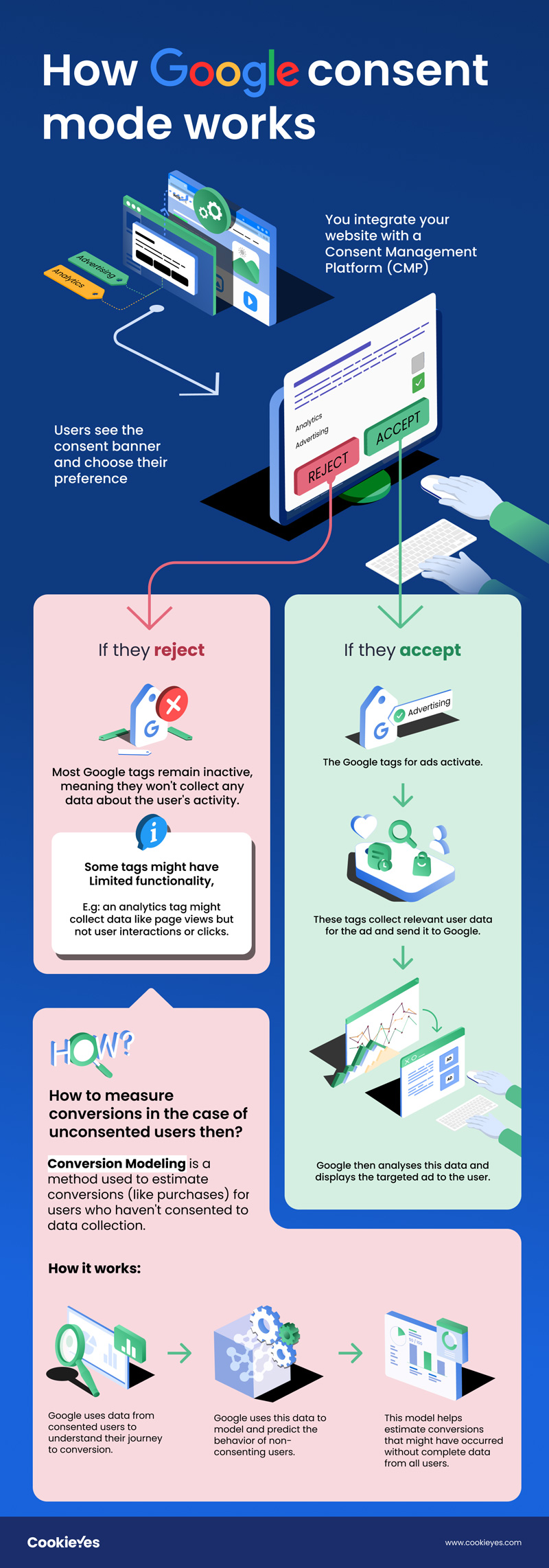
Infographic by CookieYes
What has changed with Consent Mode V2?
There are two new types of consent signals that websites need to send to Google.
ad_user_data
This controls whether Google is allowed to use any personal data for advertising, such as device or IP information. If the user has not given consent, this data stays restricted.
ad_personalization
This decides whether personalised ads and remarketing are allowed. If a user says no, they cannot be added to remarketing lists or shown tailored adverts.
These signals give you far more control and help Google behave in a way that aligns with GDPR expectations.
Why your website needs Consent Mode V2
Now we get to the important part. Consent Mode V2 is not something you can skip if you rely on analytics or advertising. Here is why.
1. It keeps you on the right side of privacy law
GDPR requires explicit consent before you use tracking that collects personal data. If your website loads analytics or advertising scripts before consent has been given, you may be breaking the rules. Consent Mode V2 helps make sure Google’s scripts behave correctly so you stay compliant.
2. It protects your analytics
Without Consent Mode V2, a large number of your visitors simply disappear from your reports if they say no to cookies. This means inaccurate data and decisions based on guesswork. Consent Mode V2 gives you privacy friendly, modelled insights so you can still see what is happening.
3. It is essential for Google Ads
Google Ads relies on conversion tracking. If you lose that data, your campaigns become more expensive and less effective. Smart bidding struggles, remarketing lists shrink and your ads stop performing as they should. Consent Mode V2 allows Google to keep receiving lawful, aggregated information so your campaigns still work.
4. It prepares your website for a cookieless future
Browsers are already blocking third party cookies and privacy laws are getting stricter. Consent Mode V2 is Google’s way of helping businesses adapt. Putting it in place now means you stay ahead rather than scrambling later.
Who needs to implement Consent Mode V2?
If any of the following apply, then you need it.
You use Google Analytics
You run Google Ads
You use Google Tag Manager
You use remarketing or retargeting
You receive visitors from the UK or EU
You rely on conversions to measure performance
In reality, this covers most small and medium sized businesses.
What happens if you do not install it?
Here is the honest list.
Your analytics becomes unreliable
Conversions in Google Ads stop tracking properly
Remarketing lists shrink
Advertising becomes less efficient
You risk GDPR compliance issues
You lose sight of how your website performs
Skipping Consent Mode V2 is a bit like removing your car’s dashboard because warning lights were distracting you. It might feel quieter, but you will not know when something is going wrong.
In summary…
Google Consent Mode V2 is not just another technical update. It is a major shift in how websites collect and use data in a way that respects privacy and still gives you enough information to make good marketing decisions.
If your website uses Google Analytics, Google Ads or remarketing, then you need it. With Consent Mode V2 in place, you stay compliant, your reports stay useful and your advertising continues to perform.
Without it, you face patchy data, weaker marketing results and greater risk as privacy rules continue to tighten.
Consent Mode V2 helps you protect your users while still running a smart, data driven business. Once it is set up properly alongside a CMP, it quietly takes care of everything in the background.